Saudi Arabia’s Infrastructure Boom: Opportunities for Industrial Suppliers
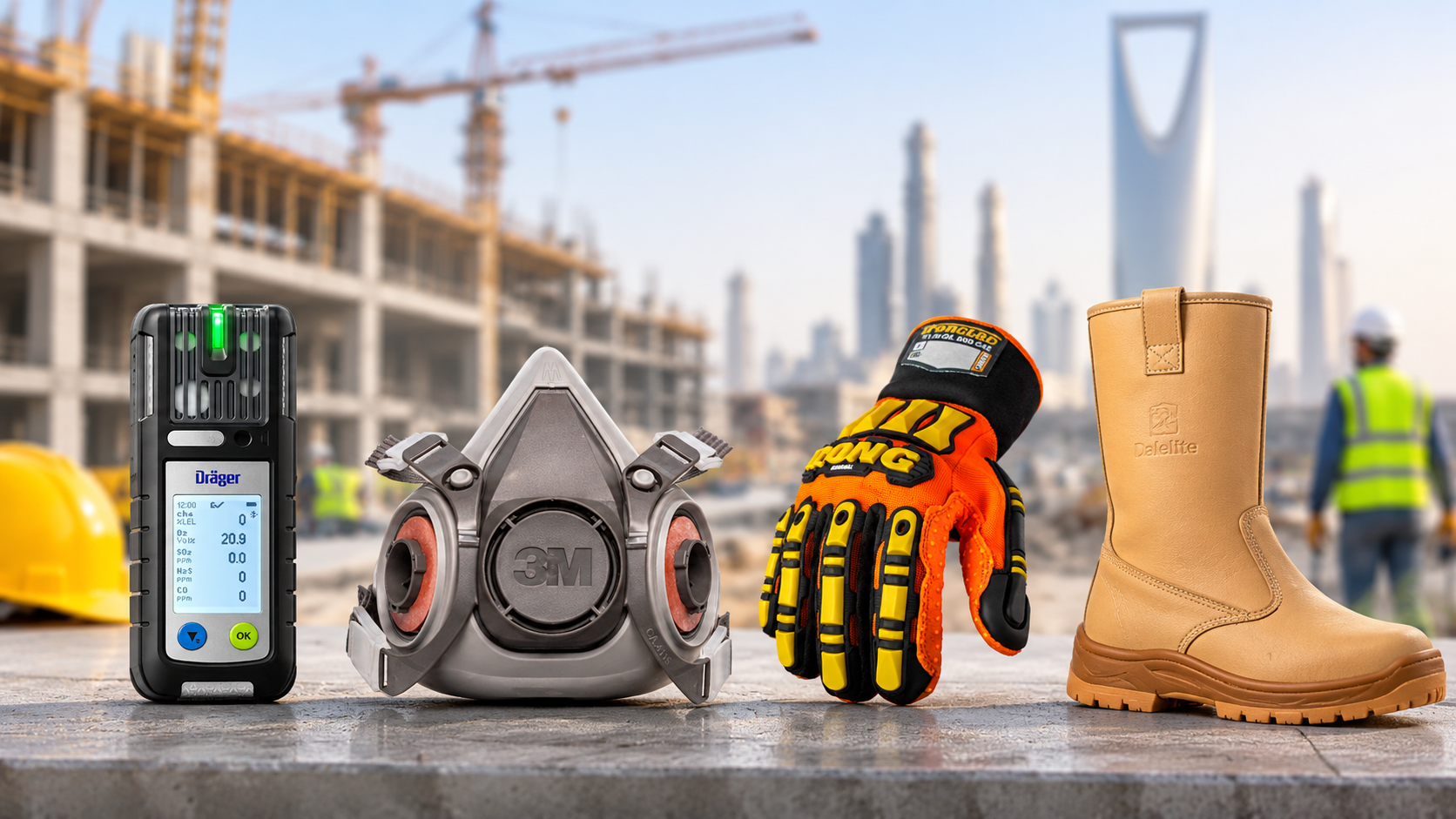
Saudi Arabia’s Vision 2030 programme has driven one of the largest construction build-outs in the world, with new cities, airports, tourism destinations, stadiums and transport links. For industrial and safety suppliers, it has been a major source of demand across the Gulf.
But the picture in late 2026 is more nuanced than the headlines suggest. Spending is being reprioritised, and some projects have been scaled back or postponed. Others are accelerating because they are tied to fixed international deadlines. Suppliers who understand this shift, and who prepare for the compliance requirements that come with it, are the ones best placed to win long-term business.
This guide explains where the opportunities are heading, what is changing in Saudi safety regulation, and how industrial suppliers can position themselves for the next phase.
The 2026 picture: a shift, not a stop
Giga-project contract awards stand at $10.6 billion so far this year. That is down from a 2023 peak of $31.7 billion. MEED attributes most of the decline to the scaling back of Neom, including the postponement of The Line and the Trojena ski resort, rather than to a broad retreat from the programme.
Three details matter for suppliers.
Giga-projects were never the whole market. MEED estimates they account for roughly 17% of the $700 billion awarded across the Kingdom over the past decade. A large share of activity sits outside them, in housing, utilities, transport, hospitality, healthcare and industrial facilities.
Spending is concentrating in Riyadh. Qiddiya and Diriyah, both on the outskirts of the capital, drew most of this year’s giga-project awards. MEED expects the next wave to come from King Salman International Airport, Expo 2030 and the stadiums for the 2034 World Cup, with activity picking up from 2027.
Overall awards have softened. The same report puts total Saudi contract awards at $76 billion through October, compared with $102 billion last year. Tabuk province, home to Neom, was hit hardest, while Riyadh still takes the bulk of spending.
The practical lesson is that “Saudi Arabia” is no longer one uniformly booming market. It is a set of regional and sector-specific opportunities, and the strongest ones are tied to deadlines that cannot move.
The deadlines that keep demand alive
Two fixed dates anchor the next phase of construction.
Expo 2030 Riyadh
Runs from 1 October 2030 to 31 March 2031. According to Gulf Business, it is planned on a six-million-square-metre site designed to accommodate more than 40 million visits. A site of that scale needs years of civil works, building construction, utilities installation and fit-out before the first visitor arrives.
The 2034 FIFA World Cup
Will be hosted by Saudi Arabia. Stadiums, transport links, fan zones and hotels all need to be ready, which keeps the Riyadh-centred pipeline active well beyond 2030.
Projects tied to international events tend to be protected when other budgets are reviewed. For suppliers, that means a more predictable stream of work in the years ahead, particularly in and around the capital.
Why safety and industrial supply is a durable opportunity?
Construction value rises and falls with contract awards. Demand for safety equipment follows two other forces: how many people are on site, and how strictly rules are enforced.
On the second point, the direction of travel in Saudi Arabia is clear.
Tougher rules for high-risk work
Saudi Arabia adopted the Regulation on Organising Work in High-Risk Professions, which Pinsent Masons reports was scheduled to take effect on 3 July 2026. It applies to employers in sectors such as construction, heavy equipment operations, welding, cutting and mechanical work.
The regulation covers activities such as:
- Working at height or in confined spaces
- Working in high temperatures or direct sunlight
- Manual lifting and transport of loads
- Working near moving vehicles or equipment
- Exposure to noise, heat or vibration
- Welding and cutting
- Handling chemicals
For workers in these roles, the regulation introduces licensing, medical fitness examinations and competency requirements. Employers also take on duties to notify hazards and to investigate and report accidents.
The regulation does not name specific products, but it raises the profile of workplace safety across the whole employer base. When compliance expectations rise, employers tend to look harder at what their crews wear, carry and use.
Matching hazards to equipment
Each hazard in the regulation has a practical protective solution. Here is how the main ones line up with the equipment categories we supply:
| Site Hazard | Typical Protective Equipment | Equipment Examples |
|---|---|---|
| Confined spaces, toxic or flammable gases | Single gas detectors and multi-gas monitors | BW Clip Single Gas Detector MSA ALTAIR 5X |
| Dust, vapours, chemicals | Reusable respirators with matching cartridges and filters | 3M 6800 Full Facepiece |
| Emergency escape from toxic atmospheres | Escape hoods for emergency evacuation | Avon NH15 Escape Hood |
| Heavy machinery noise | Hearing protection against excessive noise | Ear Protection |
| Falling objects | Protective hard hats | Bullard 3-Rib S61 |
| Impact and handling injuries | Impact-resistant protective gloves | KONG Impact Gloves |
| Slips, crush and puncture risks underfoot | Protective safety footwear | Jallatte JALASKA SAS |

Product categories to watch
Gas detection
Large infrastructure projects involve tunnels, shafts, tanks, pipelines and basements, all places where hazardous atmospheres can build up. Portable gas detectors are standard equipment for permit-to-work systems in these environments.
Single-gas units such as the BW Clip are widely used for dedicated hazards like H2S. Multi-gas instruments such as the Dräger X-am 5800 or the Industrial Scientific Ventis MX4 suit work where several gases must be monitored at once. Because detectors need regular maintenance, replacement sensors and spares create recurring demand over the life of a project.
Respiratory protection
Cutting, grinding, painting, coating and demolition all put particles, fumes and vapours into the air. Reusable half-face and full-face respirators, such as the 3M 6200 and 3M 6800, are paired with cartridges and filters chosen for the specific hazard. Options include the 3M 6059 ABEK1 cartridge for gas and vapour protection and particulate filters for dust. Escape devices like the MSA MiniSCAPE and Dräger PARAT complement them where emergency evacuation is a concern.
Cartridges and filters are consumables, so a single respirator sale usually leads to repeat orders.
Head, hearing and hand protection
These are the high-volume basics of any large site. Hard hats such as the 3M SecureFit H-700SFR-UV and Bullard S71 protect against falling objects. Hearing protection, from PELTOR earmuffs to foam earplugs, addresses the noise exposure that the new regulation specifically lists. Impact-resistant gloves like the KONG SDX2 reduce hand injuries in heavy handling work.
Medical readiness and AEDs
Large worksites, stadiums, exhibition halls, airports and transport hubs bring together very large numbers of people. Sudden cardiac arrest can happen anywhere, and survival depends on how fast a defibrillator can be used.
We supply AED defibrillators from brands including Philips, Zoll, HeartSine, Defibtech and Physio-Control. We also supply the accessories that keep them ready, such as adult pads, pediatric pads and replacement batteries. Pads and batteries have expiry dates, which makes them a recurring need. Our AED calibration service helps owners keep devices in working order.
What to Look for When Choosing an AED?
- Ease of use. Clear voice prompts and simple operation matter most when the person using it has never done so before.
- Children. Some models use separate paediatric pads or a child key, so check what your model needs and keep the right accessory with it.
- Language. Check which languages the device’s voice prompts support.
- Running costs. Pads and batteries expire and must be replaced, so ask about their life and cost.
- Where it will be kept. Check the manufacturer’s temperature and environment range against the place you plan to store it.
- Self-checks and records. Look at how the device shows its readiness, and whether it stores data you may need.
- Support. Confirm that pads, batteries and servicing will be available for your model.
Where the demand will come from?
Because spending is concentrating around Riyadh, it helps to think by sector rather than by region alone.
Construction and civil works
Airports, stadiums, roads, rail and utilities need large volumes of everyday PPE, plus gas detection for underground and enclosed work.
Hospitality and tourism
Skift, citing Lodging Econometrics, reports that Saudi Arabia had 387 hotel projects in its pipeline in the second quarter, up 13% year over year. Hotels, resorts and venues need fire safety, first aid, AED coverage and fit-out PPE as they are built and then operated.
Industrial and facilities management
Once buildings are complete, operators need ongoing safety supplies, from respirator cartridges to detector calibration. This steadier, repeat business is often more valuable than one-off project sales.
Events and venues
Expo 2030 and the World Cup will require large-scale crowd safety and emergency medical preparedness, including defibrillators in public spaces.
Practical advice for suppliers
- Follow the pipeline, not the headline. Track where contracts are actually being awarded. Based on current reporting, Riyadh-linked projects are likely to lead from 2027.
- Put compliance first. Check SABER and conformity requirements before you quote, not after the order is placed. Customers on large projects will ask for documentation.
- Stock consumables as well as hardware. Respirator cartridges, filters, AED pads and gas-detector sensors are bought repeatedly. Explore our brand pages for 3M, Dräger, MSA Safety, Crowcon, Karam, UVEX and Salisbury.
- Plan logistics early. Fast, reliable delivery to Riyadh, Jeddah and Dammam matters as much as price on a tight programme. Confirm lead times and whether duties and taxes are included before you commit.
- Support what you sell. Calibration, spares and user guidance keep equipment compliant and keep customers returning. Safety equipment that is poorly maintained does not protect anyone.
- Build relationships. Large contractors value suppliers who are responsive and consistent. Reliable service over several projects is what leads to approved-vendor status.
Regulation: Check Before You Buy
Medical devices in Saudi Arabia are regulated by the Saudi Food and Drug Authority (SFDA). Its requirements document, MDS-REQ 1, states that a medical device may be made available in the Kingdom only if it is registered with the SFDA and holds a medical device marketing authorization (MDMA). Requirements are updated from time to time, so always check the SFDA’s current documents.
Hamid Safety is a Dubai-based supplier. Our site lists delivery to Saudi cities including Riyadh, Jeddah and Dammam, but regulatory status depends on the specific product, so please confirm it with our team and with the SFDA before ordering any medical device for use in the Kingdom.
Equip Your Saudi Project with Hamid Safety
Hamid Safety supplies gas detectors, respirators, head, hearing and hand protection, AED defibrillators and related safety equipment from leading brands such as 3M, MSA, Dräger, Crowcon and Bullard. Tell us your project type, the quantities you need and the products you are considering, and we will advise on options, availability and delivery to Saudi Arabia.